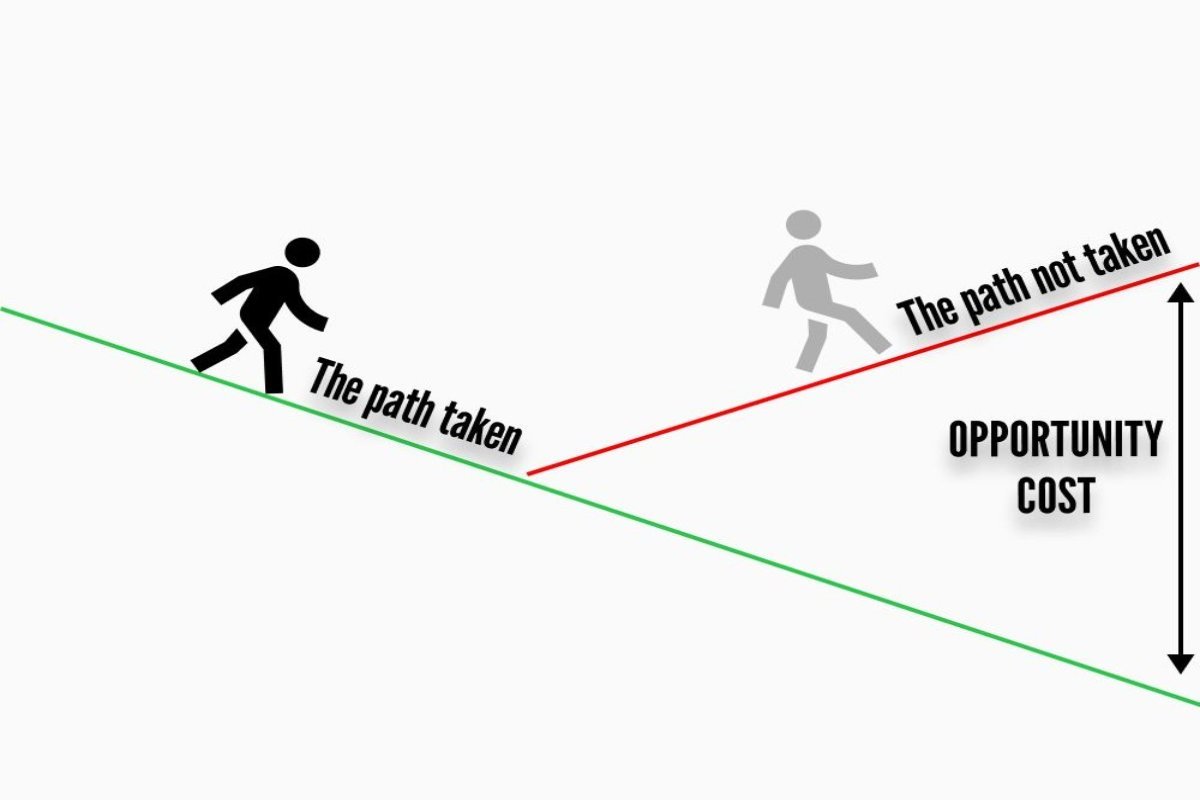
Think of Opportunity Cost as the "Hidden Price Tag." Always ask what you give up.
Lets understand this with a Simple Example: Friday Night
You have two choices for Friday night:
- Go to the movies with friends.
- Work a shift at your part-time job and earn $50.
If you choose the movies, the "cost" isn't just the $15 movie ticket. The Opportunity Cost is the $50 you didn't earn. So, that movie actually "cost" you $65 of potential value ($15 spent + $50 not earned).
It’s not just about money (It’s about TIME)
This is the most important part. You can always get more money, but you can never get more time.
- If you spend 3 hours scrolling on TikTok, the opportunity cost is the 3 hours you could have spent practicing guitar, sleeping, or hanging out with a friend.
- The trade-off: By saying "Yes" to TikTok, you are automatically saying "No" to the guitar.
Why this is a "Mental Model"
Most people only look at what they are gaining. Smart people always look at what they are giving up.
- The "Chauffeur" move: "I should buy this $1,000 laptop because it’s 20% off! I’m saving $200!"
- The "Planck" move: "If I spend $800 on this laptop, what is the next best use for that $800? Could it buy me a bike to get to work faster? Could I invest it so it becomes $1,200 next year?"
How to use the "Opportunity Cost Filter"
Whenever you’re about to make a big choice, don't ask "Is this good?" Ask: "What is the next best thing I’m killing by doing this?"
If the thing you're doing is better than the "next best" thing, you’re making a great decision. If not, you’re losing out; even if the decision feels "good" in the moment.
The Lesson: Every "Yes" is a "No" to a thousand other things. Make sure your "Yes" is worth all the "No's."
If you had one extra hour today, what would be the "next best use" of that time besides what you already have planned?